Function
- 函数是对象.
- 函数提供局部作用域.
- Object 是 Function 的实例对象, Function.prototype是 Object 的实例对象.
const truthy = Object[[proto]] === Function.prototype // true
const truthy = Function[[proto]] === Function.prototype // true
const truthy = Function[[proto]][[proto]] === Object.prototype // true
Implicit
Function Invocation普通调用模式:this绑定至全局对象/undefined(strict mode)- setTimeout 和 setInterval 中传入的 Callbacks
会自动转变为
Function Invocation,thisbind to global/undefined object. - React Class Component 中传入的 Event Handlers
会自动转变为
Function Invocation, 需要显式地this.handleClick = this.handleClick.bind(this);
- setTimeout 和 setInterval 中传入的 Callbacks
会自动转变为
Method Invocation方法调用模式:this绑定至此方法所属的对象.
// Non-strict mode:
window.identity = 'The Window'

const object = {
  identity: 'My Object',
  getIdentityFunc() {
    return function () {
      return this.identity
    }
  },
}

// Function invocation:
// Anonymous closure function `this` bind to `window`.
console.log(object.getIdentityFunc()()) // 'The Window'
add(1, 2) // `this` -> `global`

const obj = {
  value: 1,
  foo() {
    // 若不将 `this` 赋值给 `that`, 而在内部函数中直接使用 `this.value`,
    // 则会发生错误: 内部函数的 `this` 指向全局对象而不是 `obj`.
    const that = this

    function inner() {
      return that.value
    }

    return inner()
  },
}

obj.foo() // 1
class Hero {
  constructor(heroName) {
    this.heroName = heroName
  }

  logName() {
    console.log(this.heroName)
  }
}

const batman = new Hero('Batman')
setTimeout(batman.logName, 1000)
// after 1 second logs "undefined"
Explicit
Apply/Bind/Call Invocation:
函数引用不可以改变函数定义作用域 (scope), 但可以改变函数执行作用域 (context).
this.construct = Foo
this.construct(options)
// =>
Foo.call(this, options)
Function.call(contextObj, arg1, arg2, ...)Function.apply(contextArray, [arg1, arg2, ...]/arguments)- call 效率高于 apply.
window.function.call()
window.function.apply()
// js解释器临时将数组/字符串包装成对象原型.
;[].arrayStaticFunction.call()
;[].arrayStaticFunction.apply()
Array.prototype.arrayStaticFunction.call()
Array.prototype.arrayStaticFunction.apply()
''.stringStaticFunction.call()
''.stringStaticFunction.apply()
String.prototype.stringStaticFunction.call()
String.prototype.stringStaticFunction.apply()
相当于:
context.function(arguments)
Bind
- Change function runtime context (ignore innovation pattern
function/method/new/call/apply). - Curry function.
- Can't change
thisin arrow function.
const boundFunc = func.bind(context, arg1, arg2, argN)
Call and Apply
function bind(o, m) {
  return function (...args) {
    return m.apply(o, args)
  }
}
const one = {
  name: 'object',
  say(greet) {
    return `${greet}, ${this.name}`
  },
}
const two = { name: 'another object' }
const twoSay = bind(two, one.say)

twoSay('yo') // "yo, another object"
Constructor
Constructor invocation (new call):
this绑定至传入的空对象.new.target引用构造函数.
function newConstructor(Func, ...args) {
  // 1. 创建一个新对象
  const obj = {}
  // 2. 新对象原型指向构造函数原型对象
  obj[[proto]] = Func.prototype
  // 3. 将构建函数的 `this` 指向新对象
  const result = Func.apply(obj, args)
  // 4. 返回对象
  return result instanceof Object ? result : obj
}
new constructor invocation >
explicit invocation >
implicit invocation >
default invocation.
Arrow Function
- No
thisbinding (lexical scope):thisdefined where arrow function defined (not called).- Not suited as method:
thisin arrow function bound to lexical scope, not bound to method receiver. apply/call/bindcan't changethisin arrow function.
- No
argumentsbinding (lexical scope). - Not suited as
newconstructor:- No
superbinding (lexical scope). - No
new.targetbinding (lexical scope).
- No
- No
function.prototype: arrow functionprototypeproperty isundefined. - No
yieldbinding: 箭头函数不能用作 Generator 函数.
const obj = {
  foo() {
    const inner = () => {
      return this.value
    }

    return inner()
  },
}

const func = obj.foo

obj.foo() // `this` in `inner` function refer to `obj`
func() // `this` in `inner` function refer to `window`
Difference between named functions and arrow functions:
This Binding
function Call | Method Call | new Call | |
|---|---|---|---|
Traditional function (sloppy) | window | receiver | instance |
Traditional function (strict) | undefined | receiver | instance |
| Method (sloppy) | window | receiver | TypeError |
| Method (strict) | undefined | receiver | TypeError |
Generator function (sloppy) | window | receiver | TypeError |
Generator function (strict) | undefined | receiver | TypeError |
| Generator method (sloppy) | window | receiver | TypeError |
| Generator method (strict) | undefined | receiver | TypeError |
Arrow function | lexical | lexical | TypeError |
| Class | TypeError | TypeError | SC protocol |
Context and Scope
- 每个上下文都有一个关联的变量对象 (Variable Object), 这个上下文中定义的所有变量和函数都存在于这个对象上.
- 每个执行环境拥有独立的作用域链, 例如独立活动对象 -> 独立全局对象:
scope chain->(list) [0]活动对象->[1]全局对象.- ES6 Block Scope -> Function Scope -> Global Scope.
- 全局上下文中关联的变量对象 (Variable Object), 会在代码执行期间始终存在.
- 函数上下文将其活动对象 (Activation Object) 用作变量对象 (Variable Object):
- 函数每次运行时, 都会新建执行环境上下文与作用域链, 执行完后销毁上下文与作用域链.
- 存在闭包时, 函数上下文关联的作用域链中被引用的活动对象不会被销毁.
- 可动态改变作用域链的语句:
with.try catch: 异常对象入列, 位于作用域链链首.
function createComparisonFunction(propertyName) {
  return function (object1, object2) {
    const value1 = object1[propertyName]
    const value2 = object2[propertyName]

    if (value1 < value2)
      return -1
    else if (value1 > value2)
      return 1
    else
      return 0
  }
}

const compare = createComparisonFunction('name')
const result = compare({ name: 'Nicholas' }, { name: 'Matt' })
执行上述代码后的上下文栈与作用域链如下图所示:
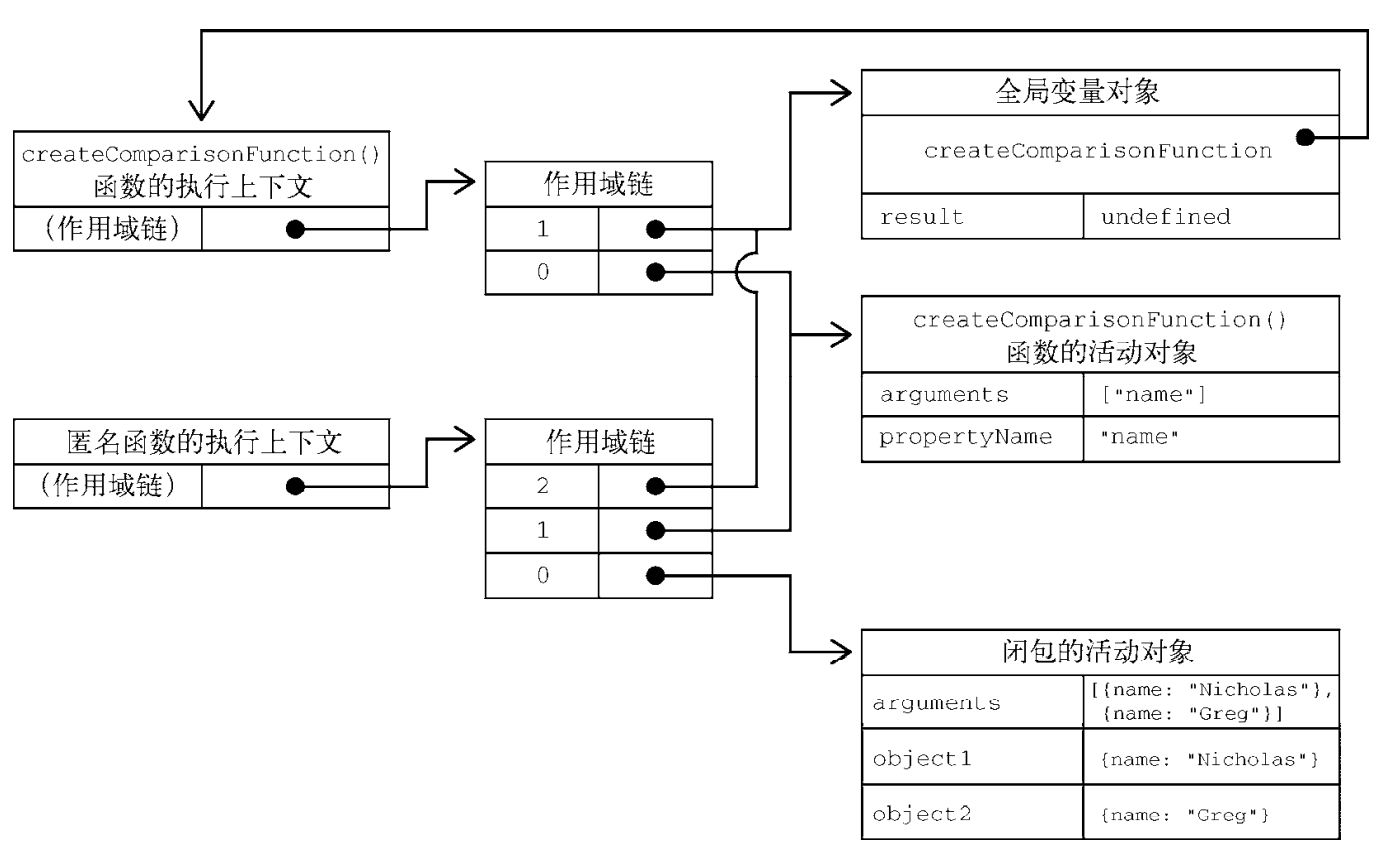
createComparisonFunction() 的活动对象并不能在它执行完毕后销毁,
因为匿名函数的作用域链中仍然存在对它的引用.
在 createComparisonFunction() 执行完毕后,
其执行上下文的作用域链会销毁,
但它的活动对象仍然会保留在内存中,
直到匿名函数被销毁后才会被销毁.
Name
- 所有函数对象都会暴露一个只读的
name属性, 其中包含关于函数的信息. - The spec operation
SetFunctionName(F, name, [, prefix])sets up functionname:- Getters and setters get prefixes
getandset. Function.prototype.bind()get prefixbound.- Function declaration name are set up when entering a scope (hoisted).
- Named function expression name are set up via
SetFunctionName(). - Arrow function and anonymous function expression name aren't set up
(
SetFunctionName()is not invoked).
- Getters and setters get prefixes
function foo() {}
const bar = function () {}
function baz() {}

console.log(foo.name) // foo
console.log(bar.name) // bar
console.log(baz.name) // baz
console.log((() => {}).name) // (空字符串)
console.log(new Function().name) // anonymous
console.log(foo.bind(null).name) // bound foo

const dog = {
  years: 1,

  get age() {
    return this.years
  },

  set age(newAge) {
    this.years = newAge
  },
}

const propertyDescriptor = Object.getOwnPropertyDescriptor(dog, 'age')
console.log(propertyDescriptor.get.name) // get age
console.log(propertyDescriptor.set.name) // set age
Prototype
- 实例化对象没有 prototype 属性.
- 每个函数都有
prototype属性. prototype属性指向函数的原型对象 (由 JS 引擎自动创建).- 每个函数的
__proto__都指向Function.prototype.
Arguments
- 函数的参数在内部表现为一个数组: 函数不关心参数个数与参数类型, 不存在验证命名参数的机制.
arguments不是真正的数组, 但有length属性 (实参个数).
Arguments Callee
- 引用 arguments 所属 function, 可以利用 callee 实现匿名递归函数.
arguments.callee.length: 即function.length, 形参个数.- 严格模式下禁止使用
arguments.callee.
try {
  // eslint-disable-next-line no-caller -- arguments.callee is deprecated
  if (arguments.length !== arguments.callee.length)
    throw new Error('传递的参数个数不匹配')
} catch (err) {
  console.log(err)
  return this
}
Parameters
- 所有函数参数都是按值传递 (复制原子值/引用值).
function.length: number of parameters before the first one with a default value.- 无副作用的函数: 注意是否需要拷贝传入对象, 使原有对象不受函数影响, 并返回新对象.
const obj = {
  value: 2,
}

function setValueEffect(obj, val) {
  obj.value = val
  return obj
}

function setValuePure(obj, val) {
  const instance = extend({}, obj, { value: val })
  return instance
}
Default
默认参数:
- 默认参数可以使用原子值/对象值/函数返回值.
- 函数调用且未传参时, 默认参数才会进行求值.
- 默认参数按照从左往右的顺序进行求值.
// Mark required parameters via a function that throws an exception
function foo(required = throwException()) {}
Rest
- Rest parameter is array containing all remaining arguments.
- Rest parameter can only be last parameter.
// Enforcing a maximum parameters
function f(x, y, ...empty) {
  if (empty.length > 0)
    throw new Error('Redundant parameters!')
}
Declaration
- 函数声明提升: 函数声明会在代码执行之前获得定义.
console.log(foo.name)

// Function Declaration 函数声明:
function foo() {}

const obj = {
  say: function say() {},
}
- 函数声明对于函数内部而言无法修改:
const b = 10
;(function b() {
  b = 20
  console.log(b)
})()

// print out function b { ... }
Expression
任何时候, 只要函数被当作值来使用, 它就是一个函数表达式:
// 函数表达式:
const foo = function foo() {}

// `function f() {}` 是命名函数表达式:
const factorial = function f(num) {
  if (num <= 1)
    return 1
  else
    return num * f(num - 1)
}
The name funcExpr only exists inside the function body:
const func = function funcExpr() {
  return funcExpr
}

assert.equal(func(), func)
assert.throws(() => funcExpr(), ReferenceError)
IIFE
立即函数模式 (Immediately Invoked Function Expression), 通过调用立即匿名函数, 返回一个对象, 暴露公共接口 (Exposed to Public):
- IIFE Syntax:
- 函数表达式.
- 末尾添加括号(传参), 使函数立即执行.
- 将整个函数置于括号内.
- 闭包: 定义私有变量与特权方法.
- 返回对象: 即使通过外部代码改变返回对象的接口, 也不会影响原接口.
;(function () {
  console.log('watch out')
})()
Left hand side 不被赋予 function 值, 而被赋予函数执行后的返回值: 此返回值可设为函数, 可产生闭包.
const getResult = (function () {
  const res = 2 + 2
  return function () {
    return res
  }
})()
- 使得匿名函数内部的代码能够立即执行.
- 不泄漏只使用一次的局部变量与方法.
- 创建命名空间, 防止变量命名冲突.
const obj = (function () {
  // private member
  let name = 'tazimi'

  // private method
  // excluded in return object

  // privileged method
  function getName() {
    return name
  }

  function setName(n) {
    if (typeof n === 'string')
      name = n

    return this
  }

  // public method
  function logName() {
    console.log(name)
  }

  // 闭包
  // 公共接口: 特权/公共方法
  return {
    // 特权方法
    getName,
    setName,

    // 公共方法
    log: logName,
  }
})()
const App = App || {}
App.utils = {}
;(function () {
  let val = 5

  this.getValue = function () {
    return val
  }

  this.setValue = function (newVal) {
    val = newVal
  }

  // also introduce a new sub-namespace
  this.tools = {}
}).apply(App.utils)

// inject new behavior into the tools namespace
// which we defined via the utilities module
;(function () {
  this.diagnose = function () {
    return 'diagnosis'
  }
}).apply(App.utils.tools)
Tail Call Optimization
- Tail call optimization only work in strict mode
due to
func.argumentsandfunc.caller(forbidden in strict mode):func.argumentsandfunc.callerwill reference outer function stack frame, so can't reduce outer function stack frame. - Tail call optimization reduce function stack frame.
// Following function is not tail recursive:
function factorial(x) {
  if (x <= 0)
    return 1
  else
    return x * factorial(x - 1) // (A): Not tail position.
}

function factorial(n) {
  return facRec(n, 1)
}

// Following function is tail recursive:
function facRec(x, acc) {
  if (x <= 1)
    return acc
  else
    return facRec(x - 1, x * acc) // (A): Tail position.
}
Closure
Closure is a function that remembers the variables from the place where it is defined (lexical scope), regardless of where it is executed later:
- 函数外部不可对函数内部进行赋值或引用.
- 函数中的闭包函数可对函数进行赋值或引用 (函数对于闭包来说是外部, 即内部引用外部).
- 特权性质 (Private Getter): 从外部通过闭包方法访问内部 (函数作用域) 局部变量.
- Local Scope -> Outer Functions Scope -> Global Scope.
- 闭包中的变量全部保存在堆内存中, 防止函数结束后变量内存被自动回收.
// global scope
const e = 10

function sum(a) {
  return function (b) {
    return function (c) {
      // outer functions scope
      return function (d) {
        // local scope
        return a + b + c + d + e
      }
    }
  }
}

console.log(sum(1)(2)(3)(4)) // log 20
// BAD
function MyObject(name, message) {
  this.name = name.toString()
  this.message = message.toString()
  this.getName = function () {
    return this.name
  }

  this.getMessage = function () {
    return this.message
  }
}

// GOOD: avoid unnecessary
function MyObject(name, message) {
  this.name = name.toString()
  this.message = message.toString()
}
MyObject.prototype.getName = function () {
  return this.name
}
MyObject.prototype.getMessage = function () {
  return this.message
}
- 闭包实现封装.
- 闭包实现私有属性与方法.
- 闭包实现工厂方法.
- 闭包实现对象缓存.
const createLoginLayer = (function (creator) {
  let singleton

  return function () {
    if (!singleton)
      singleton = creator()
    return singleton
  }
})(loginCreator)
const { called } = new (class {
  count = 0
  called = () => {
    this.count++
    console.log(`Called : ${this.count}`)
  }
})()

called() // Called : 1
called() // Called : 2
Structure
- 优先级: this > 局部变量 > 形参 > arguments > 函数名.
innerFunc()has access toouterVarfrom its lexical scope, even being executed outside of its lexical scope.
function outerFunc() {
  const outerVar = 'I am outside!'

  function innerFunc() {
    console.log(outerVar) // => logs "I am outside!"
  }

  return innerFunc
}

const myInnerFunc = outerFunc()
myInnerFunc()
Callback
// check if callback is callable
if (typeof callback !== 'function')
  callback = false

// now callback:
if (callback)
  callback()
function findNodes(callback) {
  let i = 100000
  const nodes = []
  let found

  // check if callback is callable
  if (typeof callback !== 'function')
    callback = false

  while (i) {
    i -= 1

    // now callback:
    if (callback)
      callback(found)

    nodes.push(found)
  }

  return nodes
}
当回调函数为对象方法时 (特别时方法中使用 this 指针),
需同时传入对象参数,
并利用 apply/call 改变执行环境.
function findNodes(callbackObj, callback) {
  if (typeof callback === 'function')
    callback.call(callbackObj, found)
}

function findNodes(callbackObj, callback) {
  if (typeof callback === 'string')
    callback = callbackObj[callback]

  if (typeof callback === 'function')
    callback.call(callbackObj, found)
}
Lazy
Lazy function definition (self-defining function):
- 第一次执行时,进行初始化并重新定义函数变量.
- 第二次执行时,不再进行初始化(函数被重定义至真正函数).
- 第一次执行为 promise, 将重复使用的部分进行初始化, 之后的调用不再浪费新空间, 提升性能.
// definition
let foo = function () {
  // initialize code;
  const t = new Date()

  foo = function () {
    return t
  }

  // 使得第一次调用可以产生预期值,保证每次调用的行为保持一致
  return foo()
}

// first run: same behavior as second run
console.log(foo()) // t
// second run
console.log(foo()) // t
let addEvent = function (el, type, handle) {
  addEvent = el.addEventListener
    ? function (el, type, handle) {
      el.addEventListener(type, handle, false)
    }
    : function (el, type, handle) {
      el.attachEvent(`on${type}`, handle)
    }

  // 保持每次调用对外表现行为一致
  addEvent(el, type, handle)
}
Polymorphism
function greet(options, ...rest) {
  // 运用 if/switch 方法分情况调用函数, 实现多态方法.
  if (typeof options === 'string' && typeof methods[options] === 'function') {
    // 方法集中含有此方法:
    return methods[options](...rest)
  }
}
多态最根本的作用: 通过把过程化的条件分支语句转化为对象的多态性, 从而消除条件分支语句.
每个对象的职责, 成为该对象的属性与方法, 被安装在对象内部, 每个对象负责它们自己的行为. 这些对象可以根据同一个消息, 有条不紊地分别进行各自的工作.
eval
- 不要使用
eval()函数 - 不要使用字符串作参数 new Function();(会调用
eval函数) - 不要使用字符串作
setTimeOut/setInterval的第一个参数(会调用eval函数)
// Anti-pattern:
const property = 'name'
// eslint-disable-next-line no-eval -- eval is dangerous
alert(eval(`obj.${property}`))
// Preferred:
const property = 'name'
alert(obj[property])

// Anti-pattern:
// eslint-disable-next-line no-implied-eval -- eval is dangerous
setTimeout('myFunc()', 1000)
// eslint-disable-next-line no-implied-eval -- eval is dangerous
setTimeout('myFunc(1, 2, 3)', 1000)

// Preferred:
setTimeout(myFunc, 1000)
setTimeout(() => {
  myFunc(1, 2, 3)
}, 1000)