Inheritance
Prototype Proxy
可用于所有继承模式中, 减少内存消耗:
const inherit = (function () {
  // 减少继承过程中父类的实例化,减少资源消耗
  // 实例化一个空类所需资源更少
  const F = function () {}
  return function (C, P) {
    // c.__proto__ = C.prototype = f
    // f.__proto__ = F.prototype
    // F.prototype = P.prototype
    // c.__proto__.__proto__ = f.__proto__ = P.prototype
    F.prototype = P.prototype // f.__proto__ = F.prototype = P.prototype
    C.prototype = new F() // C.prototype = f
    C.prototype.constructor = C
    C.super = P.prototype // 此句可提高代码的重用性
  }
})()

Child.prototype.add = function () {
  return Child.super.add.call(this)
}
Class Simulation
复制式地继承, 将会消耗大量内存单元:
function classSim(Parent, props) {
  // 新的构造函数
  const Child = function (...args) {
    if (
      Child.uber
      && Object.prototype.hasOwnProperty.call(Child.uber, '_construct')
    ) {
      Child.uber._construct.apply(this, args)
    }

    if (Object.prototype.hasOwnProperty.call(Child.prototype, '_construct'))
      Child.prototype._construct.apply(this, args)
  }

  // 类式继承
  Parent = Parent || Object

  // 代理构造函数F
  const F = function () {}
  F.prototype = Parent.prototype
  Child.prototype = new F()
  Child.prototype.constructor = Child

  // 添加属性与方法
  for (const i in props) {
    if (Object.prototype.hasOwnProperty.call(props, i))
      Child.prototype[i] = props[i]
  }

  // return the "class"
  return Child
}

const SuperMan = classSim(Man, {
  _construct(what) {
    console.log('SuperMan\'s constructor')
  },
  getName() {
    const name = SuperMan.uber.getName.call(this)
    return `I am ${name}`
  },
})
Composite
原型继承 (设置原型) 与类式继承 (借用构造函数) 组合继承模式:
child.prototype = new Parent(); Child.prototype.constructor = Child.Parent.apply(this, arguments): 借用构造函数可以防止引用类型被迫共享.- 此模式会调用两次父类构造函数, 使得子类属性继承两次, 存在一定的效率问题.
function Parent(name) {
  this.name = name || 'Adam'
}
// Adding functionality to the prototype
Parent.prototype.say = function () {
  return this.name
}

// Child constructor
function Child(...args) {
  // 解决引用类型共享问题
  Parent.apply(this, args)
  this.childName = 'Child Name'
}

// Child.prototype = Object.create(Parent.prototype);
Child.prototype = new Parent() // 设置原型链,建立继承关系
Child.prototype.constructor = Child // 使得 Prototype 对象与 Constructor 对象形成闭环
Clone
Shallow
Object.assign:
- Enumerable: 可枚举属性扩展.
- Own: 自有属性扩展.
- Shallow: 浅拷贝扩展.
- Trigger
sourceObj.setand changesourceObj.
const dest = {}
const src = { a: {} }
Object.assign(dest, src)

// 浅复制意味着只会复制对象的引用
console.log(dest) // { a :{} }
console.log(dest.a === src.a) // true
... object spread syntax:
- Enumerable: 可枚举属性扩展.
- Own: 自有属性扩展.
- Shallow: 浅拷贝扩展.
- Not copy prototype (
__proto__). - Not copy getter and setter.
- Not trigger
sourceObj.setand not changesourceObj(create new properties).
// Shallow copy
const foo = { a: 1 }
const bar = { b: 2, c: { d: 3 } }
const foobar = { ...foo, ...bar }
console.log(foobar.c === bar.c) // true

// Not copy prototype (`__proto__`)
class MyClass {}
const original = new MyClass()
assert.equal(original instanceof MyClass, true)
const copy = { ...original }
assert.equal(copy instanceof MyClass, false)
Deep
Recursively copy all properties of an object:
function deepClone(original) {
  if (Array.isArray(original)) {
    return original.map(elem => deepClone(elem))
  } else if (typeof original === 'object' && original !== null) {
    return Object.fromEntries(
      Object.entries(original).map(([key, value]) => [key, deepClone(value)])
    )
  } else {
    // Primitive value: atomic, no need to copy
    return original
  }
}
function deepUpdate(original, keys, value) {
  if (keys.length === 0)
    return value

  const currentKey = keys[0]

  if (Array.isArray(original)) {
    return original.map((v, index) =>
      index === currentKey ? deepUpdate(v, keys.slice(1), value) : v
    )
  } else if (typeof original === 'object' && original !== null) {
    return Object.fromEntries(
      Object.entries(original).map(([k, v]) =>
        k === currentKey ? [k, deepUpdate(v, keys.slice(1), value)] : [k, v]
      )
    )
  } else {
    // Primitive value
    return original
  }
}
Using JSON.parse(JSON.stringify(obj)):
- Not copy prototype (
__proto__). - Not copy getter and setter.
- Not copy non-enumerable properties.
- Not copy Symbol properties.
- Not copy circular references.
- Not copy
undefined,function,symbol.
const obj = { a: 1, b: { c: 2 } }
const clone = JSON.parse(JSON.stringify(obj))
console.log(clone) // { a: 1, b: { c: 2 } }
Using window.structuredClone():
// Create an object with a value and a circular reference to itself.
const original = { name: 'MDN' }
original.itself = original

// Clone it
const clone = structuredClone(original)

console.assert(clone !== original) // the objects are not the same (not same identity)
console.assert(clone.name === 'MDN') // they do have the same values
console.assert(clone.itself === clone) // and the circular reference is preserved
const room1 = {
  people: ['Alan', 'Bob'],
}

const room2 = structuredClone(room1)

room2.people.push('Charlie')
room1.people.pop()

console.log(room2.people) // ["Alan", "Bob", "Charlie"]
console.log(room1.people) // ["Alan"]
Global Object
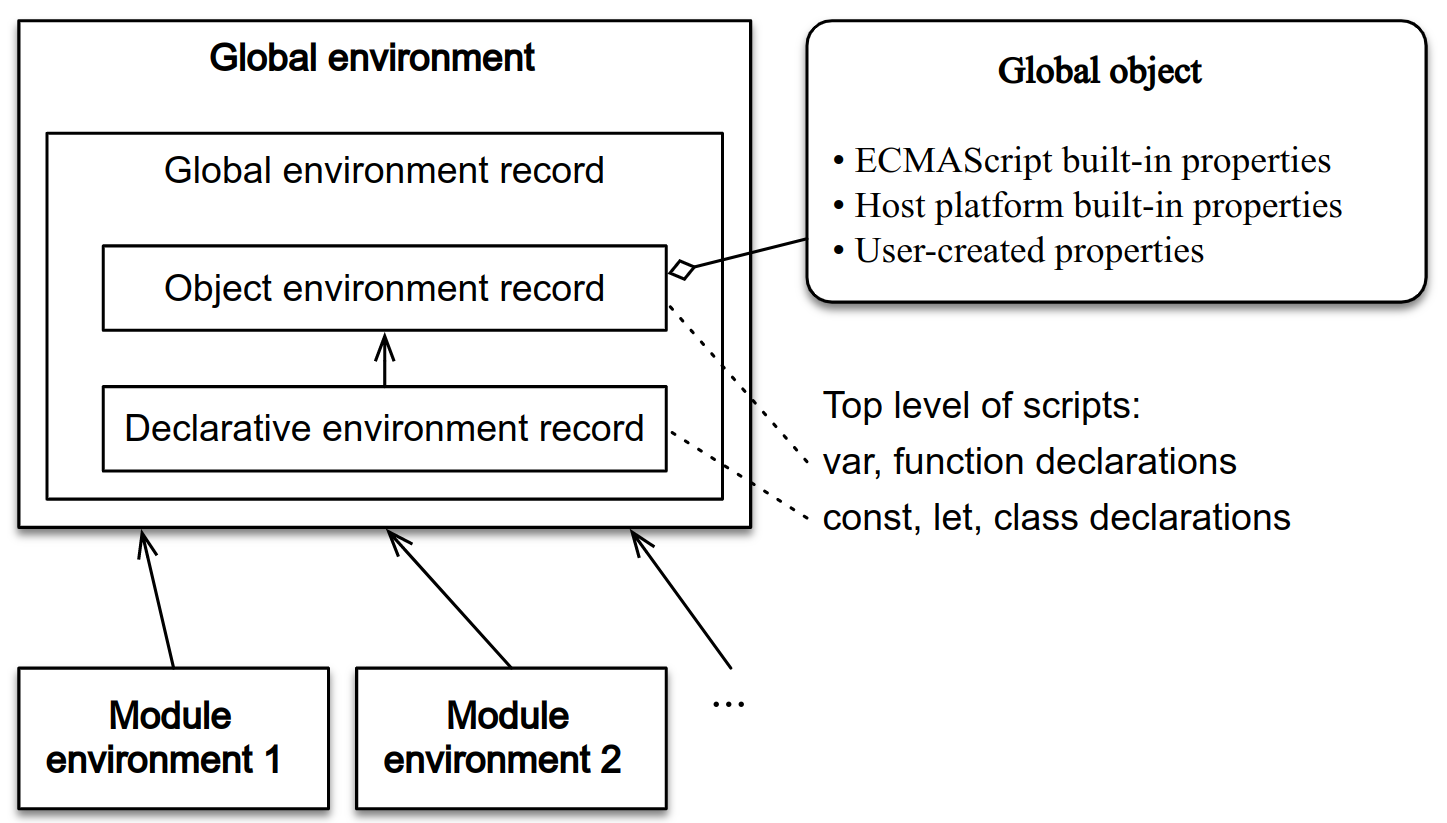
// 立即函数模式:
// 此时返回值不是函数本身, 而是函数执行后的 return 语句返回值.
const global = (function () {
  // 返回全局对象
  return this
})()
Global Object 属性:
- undefined.
- NaN.
- Infinity.
- Object.
- Array.
- Function.
- Boolean.
- String.
- Number.
- Date.
- RegExp.
- Symbol.
- Error.
- EvalError.
- RangeError.
- ReferenceError.
- SyntaxError.
- TypeError.
- URIError.
- encodeURI.
- encodeURIComponent.
- decodeURI.
- decodeURIComponent.
- eval.
;(function () {
  // Grab browser's default global variables.
  const iframe = window.document.createElement('iframe')
  iframe.src = 'about:blank'
  window.document.body.appendChild(iframe)
  const browserGlobals = Object.keys(iframe.contentWindow)
  window.document.body.removeChild(iframe)

  // Get the global variables added at runtime by filtering out the browser's
  // default global variables from the current window object.
  const runtimeGlobals = Object.keys(window).filter((key) => {
    const isFromBrowser = browserGlobals.includes(key)
    return !isFromBrowser
  })

  console.log('Runtime globals', runtimeGlobals)
})()